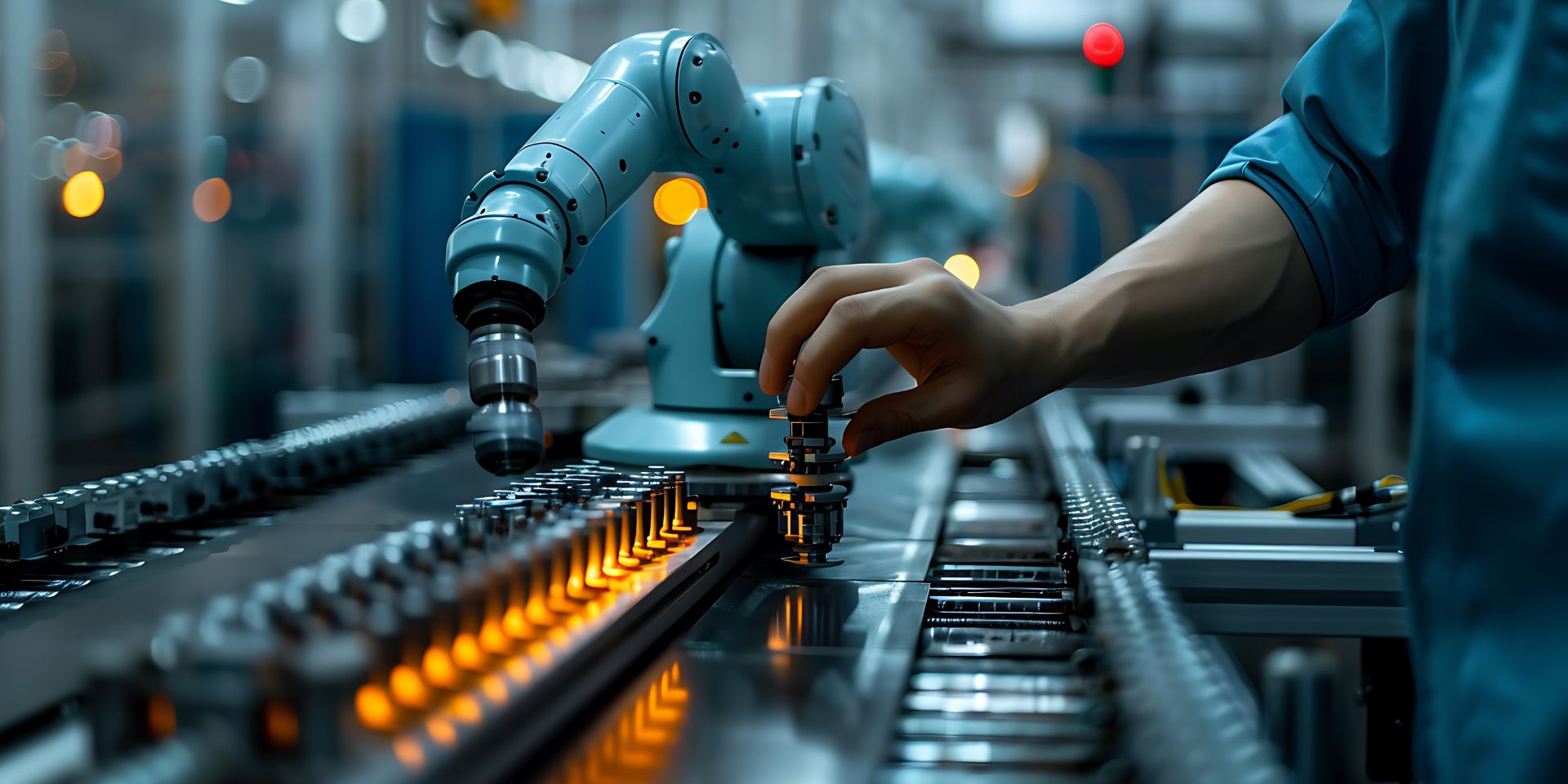
Cobots in industry: How collaborative robots can ease the workload on your production staff
Cobots are fundamentally transforming industrial manufacturing and enabling a whole new form of interaction between humans and machines. Whilst traditional industrial robots have long performed monotonous tasks behind safety barriers, collaborative robots now work directly alongside humans, providing a solution to skills shortages, increasing production demands and higher quality standards.
In this article, we’ll show you how cobots work, where you can use them and what added value they bring to your production processes — with specific examples of industrial applications.
By the way: if you’d like further inspiration on using cobots in your production, then make the most of the Robotix Impact Summit 2026 as the ideal platform to exchange ideas with leading experts and take away practical solutions.
Definition: What cobots have to do with collaboration
The term ‘cobot’ stands for ‘collaborative robot’ and refers to robots that have been specifically designed to work directly alongside humans. Unlike traditional industrial robots, cobots do not operate in isolation behind safety barriers, but share the workplace with staff. Modern sensor technology and intelligent safety mechanisms now make this close interaction possible right on the production floor.
How they work: The technology behind cobots
Cobots are based on a combination of sophisticated sensors, the right software and intelligent control systems. The aim is to enable safe movements and direct interaction with people.
Technologies that make cobots possible:
Definition: How cobots differ from robots and AI
Robots, cobots and artificial intelligence (AI) are often lumped together. They aren’t always the same thing, but they do go hand in hand. Whilst cobots are a specific type of robot, artificial intelligence, as a software technology, can be used in both cobots and other robotic systems. A brief illustration:
| FEATURE | COBOT | ROBOT | ARTIFICIAL INTELLIGENCE |
| Collaboration with humans | Direct collaboration | Usually separated by safety systems | No physical machine required |
| Flexibility | High | Medium | Very high |
| Safety functions | Integrated | External safety measures required | Software-based |
| Typical tasks | Assistance and support | Highly automated processes | Data analysis and decision support |
| Programming | Simple and intuitive | More complex | Algorithm-based |
| Field of application | Production, logistics, assembly | Mass production | Many industries |
Robots primarily handle automated movements and processes, whereas cobots have been specifically designed to work alongside humans, and AI provides the technological intelligence behind the scenes. It analyses data, recognises patterns and can support decision-making. It is precisely this combination that opens up enormous potential for industry: AI can make cobots and robotic systems significantly more intelligent, flexible and efficient. This creates production environments in which humans, robotics and AI optimally combine their respective strengths.
Applications for cobots: Where collaborative robots can ease the workload
New cobot applications are constantly emerging in industry and logistics. Here are a few examples to inspire you.
In manufacturing, cobots are used for tasks including:
Pros and cons: What cobots can do and where they still have weaknesses
Cobots offer both economic and ergonomic benefits. However, despite their many advantages, there are of course also challenges associated with the use of collaborative robot systems. We outline both sides:
An overview of the benefits of cobots
- Significant relief for employees
Physically demanding tasks are reduced. In the long term, this can reduce absenteeism, minimise ergonomic strain and improve employee satisfaction. - Greater flexibility in production
Cobots can often be quickly reconfigured and deployed for new tasks. This is particularly relevant in high-variety production. - Lower barriers to entry than traditional robots
Compared to traditional industrial robots, many cobots are more affordable, easier to programme and quicker to implement. Affordable cobots in particular make automation an attractive option for smaller businesses too. - Improved quality of work
Through precise repetition, cobots can reduce production errors and improve process quality. - Ideal support in the face of a skills shortage
Cobots take on monotonous tasks, whilst employees can focus more on value-adding tasks.
Disadvantages of cobots and typical challenges
- Limited payload
Cobots are usually unable to move extremely heavy loads like traditional industrial robots. - Lower speed than traditional robots
For safety reasons, cobots often operate slower than other industrial robots. - High safety requirements
Even though cobots are safety-optimised, companies must carry out comprehensive risk assessments. Collaborative robotics is subject to standards including ISO 10218, ISO/TS 15066, the Machinery Directive and CE marking. These standards define requirements for safety, force limitation and human-robot collaboration. - Initial investment costs
The introduction of cobots incurs costs for hardware, integration, training and maintenance.
Despite these challenges, the benefits outweigh the costs for many companies: cobots create a flexible and future-proof production environment in which the workload on humans can be specifically reduced and processes made more efficient.
Example applications: How cobots deliver real benefits
Numerous real-world examples of cobot applications in industry demonstrate just how versatile cobots are today. Whether in welding, assembly or quality control – collaborative robots are already successfully supporting day-to-day production in an increasing number of companies.
1. Cobots in welding
In welding, cobots are particularly useful for:
This helps to reduce ergonomic strain on employees.
2. Assembly in the automotive industry
Car manufacturers use collaborative robots for:
The combination of human fine motor skills and robotic precision significantly boosts efficiency.
3. Electronics manufacturing
In electronics manufacturing, cobots are particularly useful for:
Conclusion: Cobots as a key technology in modern manufacturing
Cobots are bringing about lasting change to the industrial workplace. Collaborative robots enable companies to achieve flexible, safe and cost-effective automation, whilst employees benefit from reduced physical strain and more efficient processes.
Cobots are becoming increasingly important, particularly in times of skills shortages, rising quality demands and the growing customisation of production. Companies that gain experience with collaborative robotics at an early stage can secure significant competitive advantages.
Tip: If you want to play an active role in shaping the future of robotics, AI and automation, you should attend the Robotix Impact Summit 2026 . There, specialists and managers will gain valuable insights into current developments, technologies and practical applications relating to the smart factory of tomorrow.
FAQ: 10 Common Questions About Cobots – With Concise Answers
1. What are cobots?
Cobots are collaborative robots designed specifically to work directly alongside humans.
2. How do cobots work?
Cobots use sensors, safety mechanisms, and intelligent controls to safely adapt their movements to humans.
3. How are cobots programmed?
Many cobots can be programmed using a teach-in method or via intuitive user interfaces.
4. What are the advantages of cobots?
Cobots reduce the workload on employees, increase flexibility, and improve production quality.
5. What are the disadvantages of cobots?
Possible disadvantages of cobots include lower speed, limited payload capacity, and high investment costs.
6. Where are cobots used?
Cobots are primarily used in industry, manufacturing, and logistics—for example, in assembly, packaging, or welding tasks.
7. What is the difference between a cobot and a robot?
Cobots work directly alongside humans, while traditional robots typically operate separately behind safety barriers.
8. Are cobots industrial robots?
Yes, cobots belong to the group of industrial robots but are specifically designed for safe collaboration.
9. What safety standards apply to cobots?
Important standards that apply to the use of cobots are ISO 10218 and ISO/TS 15066.
10. What are some examples of cobots?
Examples of cobots that have proven themselves in practice include assembly cobots, welding cobots, packaging robots, and collaborative logistics systems.

About the author
Nicole Wohnhaas
For more than 16 years, Nicole Wohnhaas has been developing conference and event formats focused on future-oriented topics in business and industry. As Congress Director of Product & Sales for the ROBOTIX Impact Summit, she is responsible for the event’s content strategy and maintains close ties with industrial companies, technology providers, and innovation leaders.
In her articles, she analyzes developments in robotics, automation, and AI and assesses their impact on production, logistics, and industrial value creation. Her focus is on practical use cases, technological trends, and the strategic issues surrounding industrial transformation.
Do you like what you read? Share this post or leave us a comment!
Comments
No Comments
Write comment

© Management Circle AG 2026