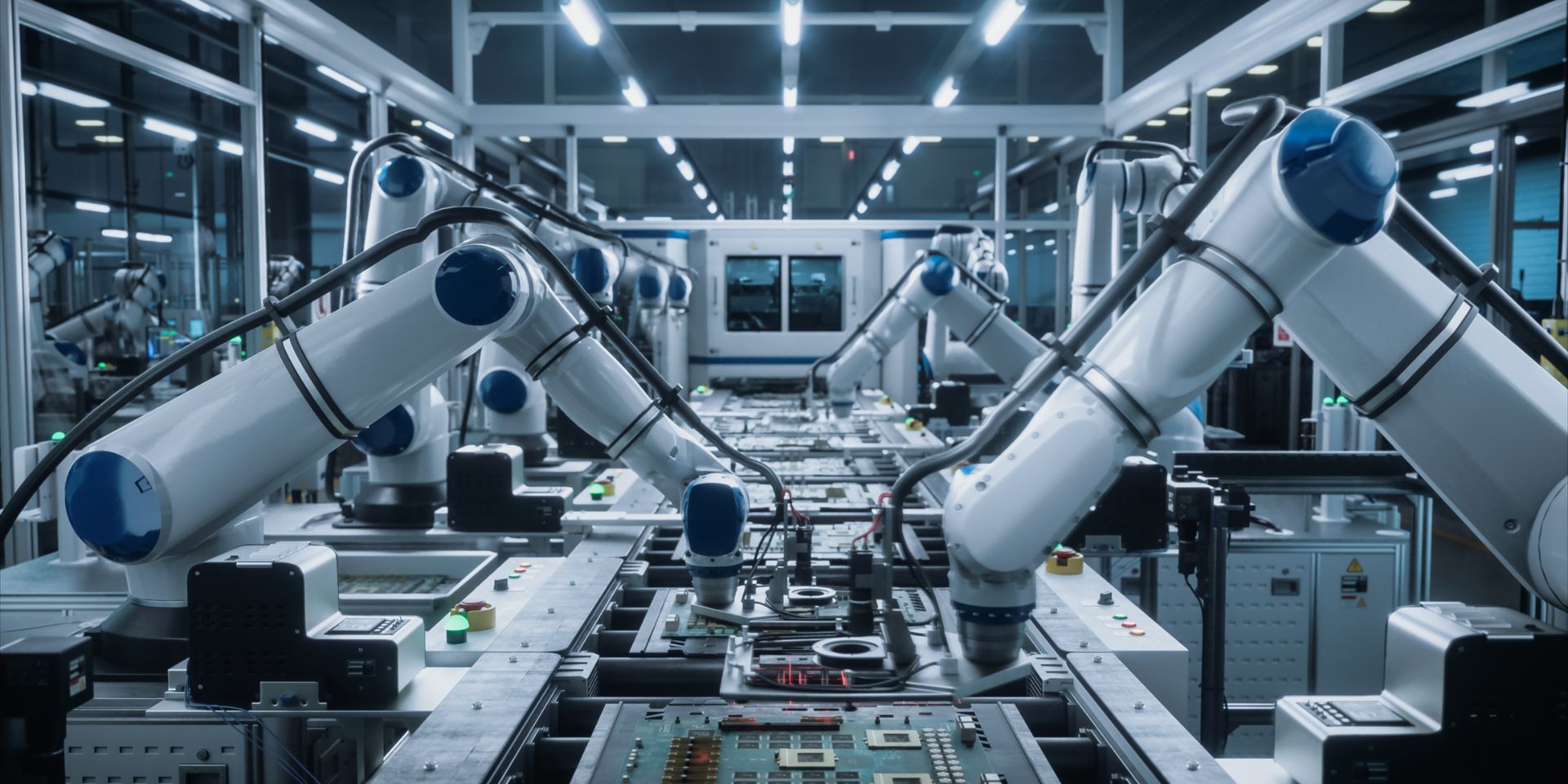
Physical AI brings AI to life: Physical AI for intelligent robots, factories and logistics systems
Physical AI brings artificial intelligence (AI) into the physical world on a large scale. Robots are learning to understand their surroundings, make decisions and act independently. Production facilities are evolving into intelligent systems, autonomous vehicles are navigating complex environments, and humanoid robots are taking on tasks that were previously the preserve of humans.
This opens up entirely new possibilities for automation within your business. But at the same time, questions naturally arise, such as: Which robots and systems can become more intelligent through Physical AI? And what impact does this technology have on the interconnection of machines and processes – think Industry 4.0 – and on Factory Intelligence?
In this article, we’ll show you where Physical AI actually comes from, what it makes possible, and how your business can benefit. Did you also know that there’s a sort of training camp for intelligent robots at Munich Airport? More on that below.
By the way: if you’d like further insights into Physical AI in manufacturing, logistics and related fields, then make the most of the Robotix Impact Summit 2026 as the ideal platform to exchange ideas with leading experts and take away practical solutions.
Physical AI explained simply: What is physical AI?
Physical AI refers to artificial intelligence that does not operate exclusively in digital environments, but interacts directly with the physical world. AI models are connected to sensors, so-called actuators and control systems, enabling machines to perceive their surroundings, make decisions and carry out actions.
So, whilst traditional AI analyses texts or makes predictions, for example, Physical AI moves out of the digital world and into real-world applications. This enables modern robots, for instance, to learn independently rather than merely executing pre-programmed sequences. Incidentally, Physical AI encompasses much more than just individual robots. Smart factories, autonomous vehicles, automated logistics systems and AI-supported energy grids can also be regarded as Physical AI systems.
A breakthrough in physical AI: Why are intelligent systems now possible?
The concept of intelligent machines – and thus of physical AI – is by no means new. Industrial robots have been in use in manufacturing environments for decades. However, these systems were mostly rule-based and limited to clearly defined tasks. The real breakthrough in physical AI has now been made possible by several technological developments occurring simultaneously:
Advances in generative AI and large foundational AI models
Powerful computer vision systems
Reinforcement learning, i.e., methods in which robots learn to make better decisions
Modern sensor technology
Edge AI, i.e., AI processing directly on the device or machine
Digital twins, i.e., virtual representations of real machines, plants, or factories
Highly realistic simulation environments
Availability of large computing capacities through GPUs
Thanks to all these developments, robots today are not only able to carry out commands, but also to understand their surroundings, learn from experience and continuously optimise their behaviour. NVIDIA, in particular, has had a major influence on this field in recent years. CEO Jensen Huang describes Physical AI as the next big wave in AI development and, in early 2026, spoke of the “ChatGPT moment for robotics”.
Physical AI vs. Generative AI: What is the key difference?
In many companies, generative AI has already become indispensable. Yet physical AI is often still in its infancy, even though it takes things a crucial step further.
| GENERATIVE AI | PHYSICAL AI |
| Operates primarily in digital environments | Operates in the real world |
| Generates text, images or code | Performs physical actions |
| Processes digital data | Processes sensor data from the environment |
| Supports decision-making | Makes decisions and acts |
| Chatbots and assistants | Robots, autonomous vehicles, smart factories |
AI or not: Which robots are considered physical AI – and which are not?
Not all AI is a robot – and not every robot uses physical AI. What matters is the ability to perceive the environment, learn from it and react independently to new situations. These types of robots typically fall under the category of physical AI:
AI-controlled cobots
Autonomous mobile robots (AMR)
Self-learning articulated-arm robots
Autonomous logistics robots
AI-assisted driverless transport systems
Autonomous vehicles
These systems utilise sensors, computer vision, AI agents or reinforcement learning and can adapt their behaviour to changing situations; however, these systems do not automatically fall under the category of Physical AI:
Learning to understand: How does Physical AI work?
Physical AI combines perception, decision-making and action within a closed-loop system. The process can be summarised in five steps:
- Sensors detect the environment.
- AI models analyse the data.
- The system evaluates possible courses of action.
- Actuators implement the decision.
- The result feeds back into the system as a learning experience.
Reinforcement learning plays a key role in this. Much like humans, robots learn through trial and error. Successful actions are ‘rewarded’, enabling the system to make progressively better decisions.
Essential: Why do we need digital twins and synthetic data?
Companies create virtual representations of factories, production facilities or robots – in other words, digital twins. Within these simulations, AI systems can run through millions of training scenarios before being deployed in the real world.
With the help of so-called World Foundation Models, synthetic data is generated that maps real-world physical relationships as accurately as possible. This, in turn, drastically reduces training times and minimises the risks associated with the use of Physical AI.
Physical AI in practice: Where are businesses already seeing the benefits?
For industrial companies, the key question is where Physical AI is already delivering tangible benefits today. And there are a number of exciting areas of application:
- Smart manufacturing
Robots independently recognise workpieces, adapt their movements and respond to deviations in the production process.
- Smart Factory
Production facilities are becoming learning systems. Machines exchange information and optimise processes autonomously.
- Cobots in assembly
Collaborative robots work directly alongside employees and assist with ergonomically demanding tasks.
- Automated Intralogistics
Autonomous mobile robots transport materials independently through production and storage areas.
- Precise quality control
AI systems detect defects that are barely visible to the human eye.
- Predictive maintenance
Physical AI systems analyse machine conditions in real time and detect potential failures at an early stage.
These examples show that Physical AI is no longer an abstract concept of the future, but is increasingly becoming a practical tool for smart factories, autonomous processes and adaptive robot systems – and this is precisely what researchers at the Technical University of Munich are working on.
RoboGym: Is there a training camp for intelligent robots?
Yes, there really is a training camp for intelligent robots. The TUM “RoboGym” ( powered by Neura), unveiled by the Technical University of Munich in early 2026, demonstrates just how great the potential of Physical AI is considered to be. The training centre is considered Europe’s largest research and development environment for Physical AI. The aim is to collect real-world motion and interaction data from robots and use it to train the next generation of intelligent robot systems.
The combination of real-world training data and simulation environments is particularly relevant here. This is because high-quality data is increasingly seen as a decisive competitive factor in the field of robotics. David Reger, founder and CEO of NEURA Robotics, emphasises the strategic importance of this development:
Challenges: Is physical AI a sure-fire success—or not?
Despite all the progress made, companies and developers face a number of challenges when it comes to the development and deployment of intelligent robotics:
- Data availability
Real-world robot data is significantly more difficult to capture than digital training data.
- Complexity of physics
Robots must be able to cope with factors such as gravity, friction, temperature and material properties.
- Real-time capability
Decisions often have to be made within milliseconds.
- Safety
In the real world, errors can have significant consequences for people, equipment or production processes.
All these challenges demonstrate that Physical AI offers enormous potential, but at the same time requires reliable data, secure technology and clear application scenarios to ensure that intelligent robotics generates genuine industrial value.
Outlook: Will Physical AI enable factory intelligence?
Physical AI will play a central role in smart Industry 4.0, robotics and the value chain in the coming years. Whilst generative AI currently supports primarily knowledge work, Physical AI will increasingly transform operational processes. Factories are evolving into smart ecosystems in which robots, machines, sensors and AI agents communicate continuously with one another – a concept known as Factory Intelligence.
In particular, the combination of humanoid robots, cobots, AI agents and Factory Intelligence could take industrial automation to a whole new level. Where does your company stand on this journey?
Conclusion: Physical AI is bringing artificial intelligence to industry
Physical AI marks the transition from purely digital AI to intelligent systems that understand their environment and actively interact with it. For businesses, this opens up new opportunities in manufacturing, logistics and industrial automation.
Those who understand early on how Physical AI, robotics, cobots and smart factories work together can make targeted use of the potential offered by this development and secure competitive advantages.
Tip: If you want to play an active role in shaping the future of robotics, AI and automation, you should attend the Robotix Impact Summit 2026 . There, specialists and executives will gain valuable insights into current developments, technologies and practical applications relating to the smart factory of tomorrow.
FAQ: 5 Common Questions About Physical AI – With Concise Answers
1. What is Physical AI?
Physical AI refers to artificial intelligence that interacts with the physical world and is used in robots, vehicles, or intelligent machines.
2. Is Physical AI the same as robotics?
No, robotics describes the development of physical machines, while Physical AI supplements these with adaptive AI systems that can make decisions and adapt.
3. Do all industrial robots fall under Physical AI?
No, traditional industrial robots with hard-coded processes are not automatically considered Physical AI.
4. What role do AI agents play in Physical AI?
AI agents handle planning, decision-making, and task coordination within Physical AI systems.
5. Why are digital twins important for Physical AI?
Digital twins enable the safe and cost-effective training of robots in realistic simulation environments.

About the author
Nicole Wohnhaas
For more than 16 years, Nicole Wohnhaas has been developing conference and event formats focused on future-oriented topics in business and industry. As Congress Director of Product & Sales for the ROBOTIX Impact Summit, she is responsible for the event’s content strategy and maintains close ties with industrial companies, technology providers, and innovation leaders.
In her articles, she analyzes developments in robotics, automation, and AI and assesses their impact on production, logistics, and industrial value creation. Her focus is on practical use cases, technological trends, and the strategic issues surrounding industrial transformation.
Do you like what you read? Share this post or leave us a comment!
Comments
No Comments
Write comment

© Management Circle AG 2026