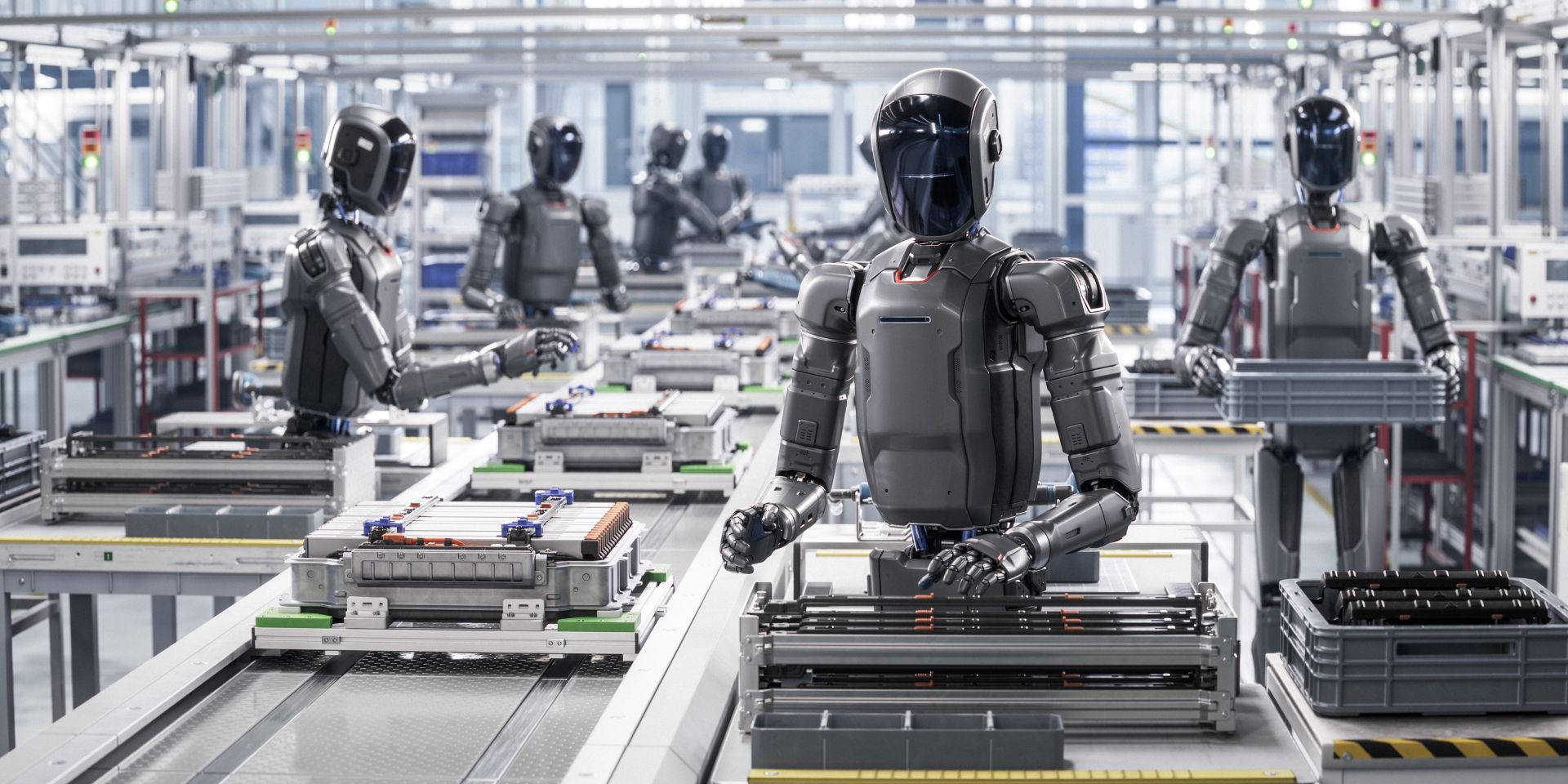
Humanoid robots: When science fiction becomes an industrial opportunity
Humanoid robots are no longer just a staple of science fiction films; instead, they are emerging as a real opportunity for manufacturing and logistics because they behave in a human-like manner. In this way, they can take on tasks that were previously designed for humans and those where traditional automation reaches its limits – for example, physically demanding routine tasks and processes that require flexibility rather than rigid specialised machinery. Companies such as BMW, Mercedes-Benz and Neura Robotics are actively driving this development forward. At the same time, research institutions such as Fraunhofer in Germany are specifically establishing test and competence environments for humanoid robotics.
So are humanoid robots the next logical step towards Factory Intelligence – or just another technological experiment? As is so often the case, the answer lies somewhere in between. Humanoid robotics has enormous potential, but it won’t transform entire factories overnight. In this article, you’ll discover where humanoid robots are already being used and how they can be successfully integrated into existing processes.
By the way: if you’d like further insights into humanoid robotics in manufacturing, logistics and related sectors, then make the most of the Robotix Impact Summit 2026 as the ideal platform to exchange ideas with leading experts and take away practical solutions.
Humanoid robots: Are they really ‘human-like’?
A so-called humanoid robot is a robot whose physique is modelled on the human form , meaning it looks human-like. Typical features include a torso, two arms, grasping hands, a head equipped with sensors, and often two legs. However, not every humanoid robot looks entirely human-like. What matters is not so much its external appearance as its ability to move and act in environments originally designed for humans.
And that is also the biggest difference compared to many traditional industrial robots. These often operate in a stationary, heavily shielded and highly specialised manner. Humanoid robots, on the other hand, are intended to operate in factory halls, warehouses or production areas where shelves, machines, tools, transport containers and workstations are already designed for human movement. This is precisely where their industrial appeal lies: they could take on tasks without the need to completely overhaul the entire environment.
This is also emphasised by robotics manufacturer Apptronik as part of a collaboration with Mercedes-Benz:
From science fiction to industrial applications: where is this already a reality?
For decades, humanoid robots were primarily a promise of the future. Today, that is no longer the case, and the focus is shifting: the question is no longer simply whether humanoid robots are technically feasible, but what tasks they can perform reliably, safely and cost-effectively.
One example is Figure AI, a manufacturer of AI robots. In November 2025, the company reported on an eleven-month deployment of its Figure-02 robot at the BMW Group Plant in Spartanburg. According to Figure, the robot operated there in 10-hour shifts from Monday to Friday, loaded more than 90,000 parts, clocked up over 1,250 operating hours and contributed to the production of more than 30,000 BMW X3s. Humanoid robots are therefore no longer merely being tested in laboratories, but are being trialled in real industrial environments.
As mentioned at the outset, Mercedes-Benz is also exploring the potential applications of humanoid robotics in collaboration with Apptronik. The aim is to pilot the humanoid robot Apollo in manufacturing environments to carry out physically demanding, repetitive and hard-to-staff tasks – in other words, precisely the activities where industrial companies face particular challenges due to a shortage of skilled workers, ergonomic requirements and pressure to maintain productivity.
Humanoid robots are thus becoming a new category of automation for tasks that were previously difficult to automate because they require adaptability, mobility and interaction in human-centred spaces.
Strengths vs. weaknesses: What do humanoid robots do particularly well?
Today, humanoid robots are particularly useful in situations where repetitive tasks are combined with varying objects, paths or positions. Their strength does not lie in outperforming traditional high-speed robots. A permanently installed industrial robot usually remains superior when it comes to welding, painting or cycle-time-optimised assembly processes. The advantage of humanoid systems lies rather in their flexibility.
Humanoid robots are particularly well suited, both now and in the future, for the following tasks:
Material handling:
Gripping, carrying, sorting and transferring parts, containers or workpieces to designated stations.
Loading and machine operation:
Supplying machines with parts, removing components, performing simple operating tasks or replenishing materials.
Precise gripping and placement:
Picking up objects, aligning them and placing them in designated positions – particularly in repeatable but not entirely rigid processes.
In practice:NVIDIA also cites material handling, alongside order picking, placement, machine operation and inspection, as current areas of application for humanoid robots.
Intralogistics:
Transporting goods, crates or components between workstations, particularly in areas not optimised for automated guided vehicles.
Ergonomically demanding tasks:
Lifting, carrying, bending down, reaching above shoulder height or repetitive hand movements that place a heavy physical strain on employees.
Simple quality checks:
Visual inspections, presence checks or the detection of obvious deviations.
Assistance in mixed working environments:
Handing tools, preparing components or supporting employees with standardised procedures.
Humanoid robots will not automatically perform tasks with greater precision than humans or conventional robots. However, they will be more precise when the task, gripper, sensors, AI model, safety concept and working environment are all well-suited to one another. For your business, this means that the right use case is key to success.
Robots compared: Which one comes out on top?
Humanoid robots complement existing automation solutions, but do not completely replace either cobots or traditional industrial robots. Rather, a new dynamic is emerging between different categories of robots, which you should understand and use effectively:
| CATEGORY | STRENGTHS | AREAS OF APPLICATION | LIMITATIONS | BENEFITS |
| Humanoid robots | High mobility, human-like movement, flexible use in human-centred workplaces, precise grasping and transport | Material handling, machine operation, intralogistics, assembly, assistance, inspection | Still high costs, limited robustness, some safety concerns, extensive training | Automation of tasks previously difficult to automate |
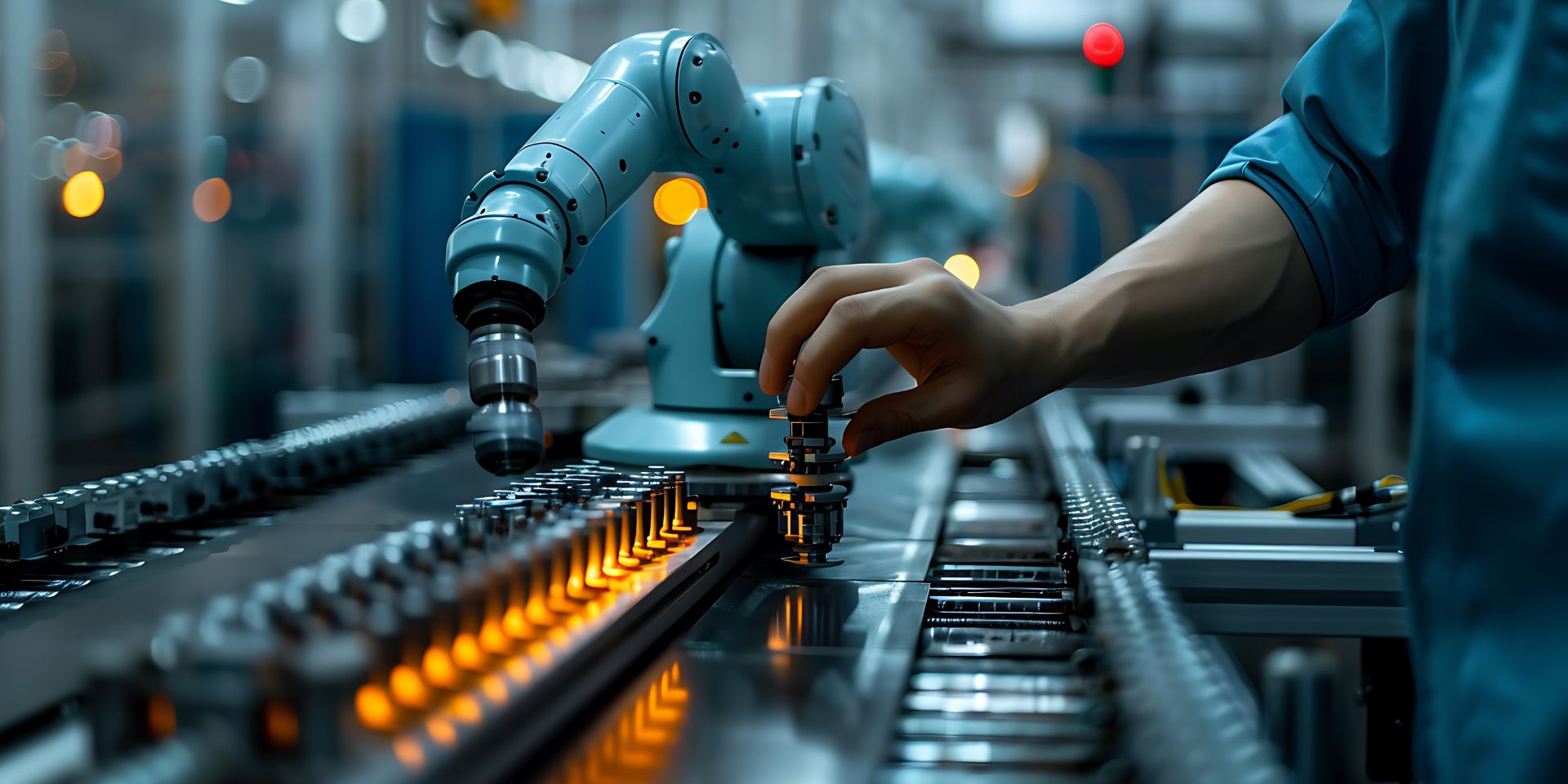
| Cobots | Safe collaboration with humans, simple programming, flexible work cells | Assembly, screwing, gluing, testing, packaging, pick-and-place | Usually limited reach, low payload and mobility | Flexible semi-automation in existing processes |
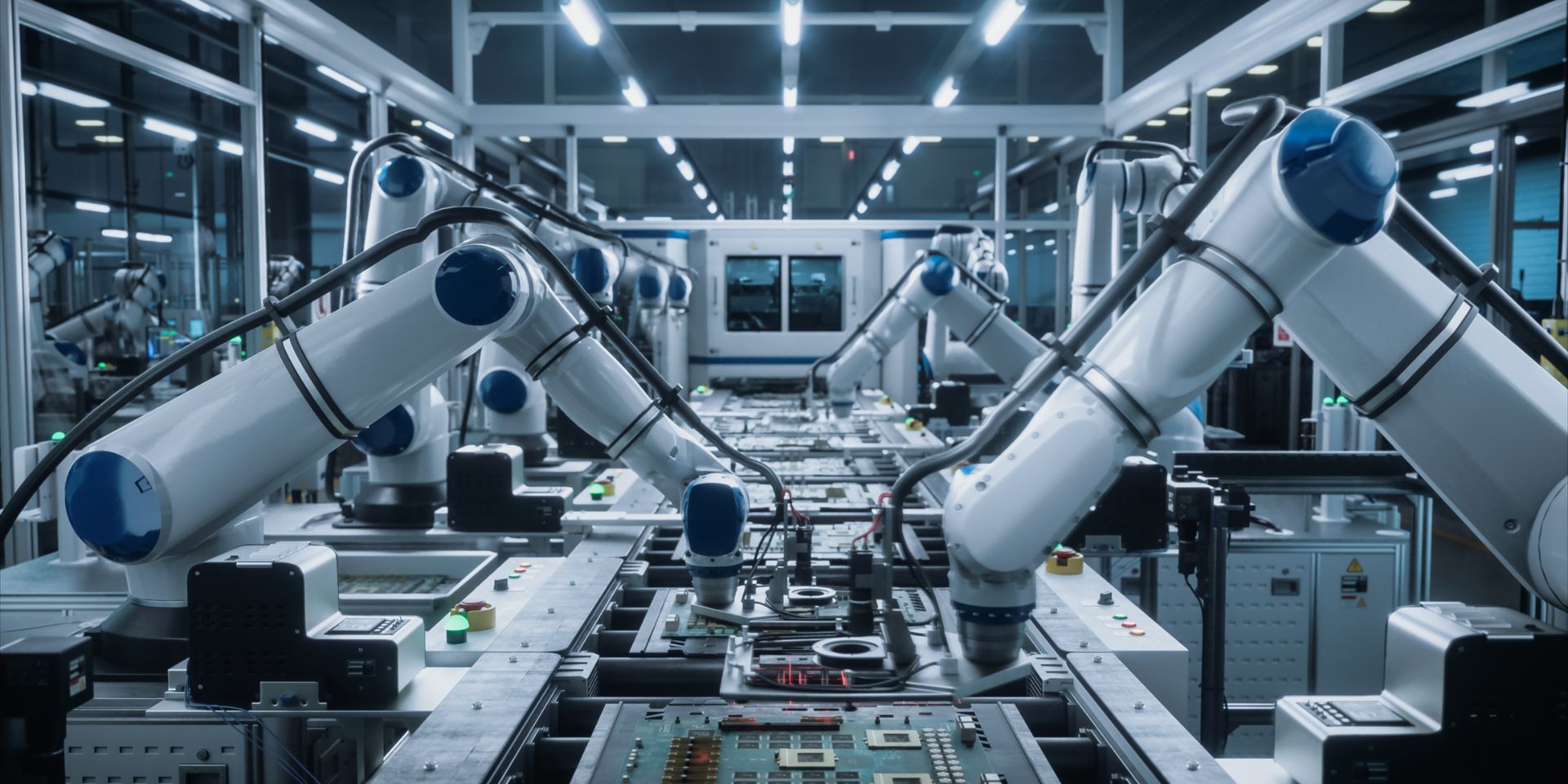
| Traditional industrial robots | High speed, high repeatability, high payload, good process stability | Welding, painting, palletising, pressing, high-volume production | Often stationary, complex integration, dedicated safety enclosures required | Maximum efficiency in clearly defined, stable processes |
The future therefore lies not so much in the question of whether to use humans or robots, but rather in finding the right combination. A traditional industrial robot can manufacture products with high precision and speed, a cobot can work flexibly alongside humans, and a humanoid robot can take on tasks that require mobility and interaction within human workspaces.
From Physical AI to Factory Intelligence: Is AI bringing hardware to life?
Behind the term Physical AI lies artificial intelligence (AI) that not only processes text, images or data, but also acts within the physical world. Humanoid robots are a particularly visible manifestation of this development, as here AI is given a body, sensors, actuators and the ability to interact with real objects.
NVIDIA positions its Isaac-GR00T technologies as the foundation for humanoid robot development. This includes models and tools for training, simulation and deployment of so-called robot ‘brains’. This approach demonstrates that humanoid robotics does not arise solely from better motors or grippers, but from the interplay of AI models, simulation, edge computing, sensor technology and real-world training data.
In industry, Physical AI is thus becoming a key enabler of Factory Intelligence – that is, an intelligent factory environment in which machines, robots, sensors, data platforms and employees work together in a networked manner. The key factor here is that AI can translate all information into concrete actions – for example, by enabling humanoid robots to move materials, operate machines and detect deviations, as well as support employees in variable production environments.
This also marks a new phase for Industry 4.0. Rather than simply connecting machines digitally, the focus today is on making physical work processes more adaptive. The smart factory is therefore not only becoming more digital, but above all more agile.
Humanoid robots in Germany: What is the current state of German development?
Germany has a strong industrial base in robotics, for example in mechanical engineering, automation technology, sensor technology, gripper technology and industrial AI. When it comes to humanoid robots, however, Germany faces international competition from the US and China, which are investing heavily in scalable hardware, capital and platform ecosystems.
One German player is Neura Robotics from Metzingen. According to the company, its 4NE1 is Europe’s leading humanoid robot, designed for precise environmental perception, human-like movement and safe collaboration with people. Neura itself speaks of safe, intelligent automation for industrial workflows and everyday situations.
Research is also gaining momentum in Germany. The Fraunhofer Institute for Manufacturing Technology and Applied Materials Research (IFAM) is establishing a training and competence centre for humanoid robotics in Stade. There, humanoid robot systems are to be tested in a practical setting – outside of ongoing operations and with direct technology transfer to companies. It is particularly important that not only do people learn how to interact with robots, but that robots also benefit from application-specific experience.
The Fraunhofer Institute for Manufacturing Engineering and Automation IPA is also investigating the potential for deploying humanoid robots in production and logistics in Germany. The aim here is to provide German industry with a sound basis for decision-making and recommendations for action regarding the use of humanoid robotics.
Germany in an international comparison: Is there a need to catch up?
Internationally, the field of humanoid robotics is developing at a rapid pace. In the US, companies such as Figure AI, Tesla, Apptronik and NVIDIA are driving forward humanoid robotics, physical AI and robotics platforms. China, for its part, stands out for its high production speed, hardware expertise and a growing number of robotics companies. Germany, on the other hand, boasts strong industrial users, excellent research and in-depth process knowledge. The pressure to act therefore lies less in building up robotics expertise in the first place, and more in translating this expertise more quickly into marketable applications, pilot projects and scalable industrial deployments.
This assessment is also supported by Bitkom: in a representative survey of German industrial companies, 68 per cent were in favour of Germany developing humanoid robots itself as quickly as possible and bringing them to the global market.
The need to catch up therefore lies less in basic technical expertise and more in the following:
- Companies need more real-world test environments. Humanoid robots do not need to impress in a showroom, but in shift work, in intralogistics, on machinery and in mixed teams.
- Clear industrial use cases are needed. Those who view humanoid robots merely as a general future technology are wasting time. Those who, on the other hand, identify specific tasks – such as parts handling, machine operation or ergonomically demanding routines – can gain experience sooner.
- Data, safety and training must be considered together. Physical AI learns from interaction with the real world. Safe training environments, transparent AI systems and qualified staff are crucial for this.
Germany is therefore well placed to make humanoid robotics commercially viable, but the competitive advantage will only emerge once research, piloting and scaling are more closely integrated and companies move more quickly from observation to testing.
Opportunities for industry and workers: What form will the relief take?
The industrial benefits of humanoid robots lie primarily in the combination of flexibility, reduced workload and the division of labour. Many companies are struggling with a growing shortage of skilled workers, an ageing workforce, an increasing variety of product variants and the intense pressure to keep production sites competitive. Humanoid robots can help here by taking on monotonous, physically demanding or hard-to-staff tasks – for example, in material handling, intralogistics or at workstations that were previously designed primarily for humans. This can be a particular advantage in historically developed brownfield environments, as not every factory is fully geared towards traditional automation.
For employees, however, this does not mean blanket replacement, but rather a shift in tasks: whilst repetitive tasks are becoming more automated, supervision, guidance, maintenance, process optimisation and human-robot coordination are gaining in importance.
Companies should therefore establish training programmes at an early stage so that employees understand which tasks are suitable for humanoid robotics, how safe collaboration can be achieved, and how they can actively contribute to identifying potential for improvement in their day-to-day work.
Limits, risks and ethical issues: what needs to be taken into account?
Despite the sector’s dynamism, however, companies must not overestimate the potential of humanoid robotics. Many systems are still in the early stages of industrial deployment. Challenges remain in terms of safety, operational life, power supply, grip reliability, robustness, costs, liability and acceptance.
Ethical issues are also relevant. Employees must understand why humanoid robots are being introduced, what tasks they will perform and what new roles this will create. Transparency is crucial here, so that robotics is perceived not as a threat but as a tool for reducing workload and fostering further development.
Added to this are data protection and surveillance issues. Humanoid robots often work with cameras, microphones, force sensors and environmental data. Companies therefore need clear rules on what data is collected, how it is processed and who has access to it.
Proceed step by step:
- Define the use case
- Assess risks
- Involve employees
- Develop a security concept
- Create a pilot environment
- Systematically evaluate learning curves
A responsible introduction does not begin with ordering a robot, but always with a clear strategy.
Conclusion: Humanoid robots are becoming a strategic issue for the industry
Humanoid robots represent a significant step forward in automation. They combine robotics, artificial intelligence, sensor technology and physical AI to create systems capable of operating in real-world work environments. Many applications are still in their infancy, but initial industrial deployments show that the technology is beginning to make the leap from the laboratory to production.
Now is the right time for your company to take a structured approach to humanoid robotics. Not every task is suitable. Not every pilot project will be immediately profitable. But those who examine use cases, train staff and create safe test environments today will gain a knowledge advantage for the next stage of the smart factory.
Tip: If you want to play an active role in shaping the future of robotics, AI and automation, you should attend the Robotix Impact Summit 2026 . There, specialists and executives will gain valuable insights into current developments, technologies and practical applications relating to the smart factory of tomorrow.
FAQ: 7 common questions about humanoid robots – with concise answers
1. What is a humanoid robot?
A humanoid robot is a robot with a human-like physique. It typically has arms, hands, sensors and, often, legs, enabling it to work in environments designed for humans.
2. When will humanoid robots be available?
Humanoid robots already exist. Many systems are still in pilot, test or early industrial deployment phases. Widespread industrial standardisation is expected to take place gradually.
3. What can humanoid robots do today?
Humanoid robots can primarily take on repetitive, physically demanding and structured tasks – such as material handling, pick-and-place, machine operation, simple inspection or transport tasks.
4. Does Germany have humanoid robots?
Yes, Neura Robotics is a German developer of humanoid robotics. In addition, research institutions such as Fraunhofer are building up expertise and test environments for humanoid robots.
5. Are humanoid robots being developed in Germany?
Yes, Neura Robotics is developing, among other things, the 4NE1 humanoid robot, and Fraunhofer is working on research, testing, qualification and technology transfer for humanoid robotics.
6. How are humanoid robots programmed?
Humanoid robots are programmed using traditional methods, trained through simulation, controlled using AI models, and are increasingly being enabled through demonstrations, voice commands or data-driven learning processes.
7. Will humanoid robots replace humans?
In industry, humanoid robots will primarily take over specific tasks, not replace humans entirely. Monotonous, dangerous or physically demanding tasks are particularly relevant.

About the author
Nicole Wohnhaas
For more than 16 years, Nicole Wohnhaas has been developing conference and event formats focused on future-oriented topics in business and industry. As Congress Director of Product & Sales for the ROBOTIX Impact Summit, she is responsible for the event’s content strategy and maintains close ties with industrial companies, technology providers, and innovation leaders.
In her articles, she analyzes developments in robotics, automation, and AI and assesses their impact on production, logistics, and industrial value creation. Her focus is on practical use cases, technological trends, and the strategic issues surrounding industrial transformation.
Do you like what you read? Share this post or leave us a comment!
Comments
No Comments
Write comment

© Management Circle AG 2026