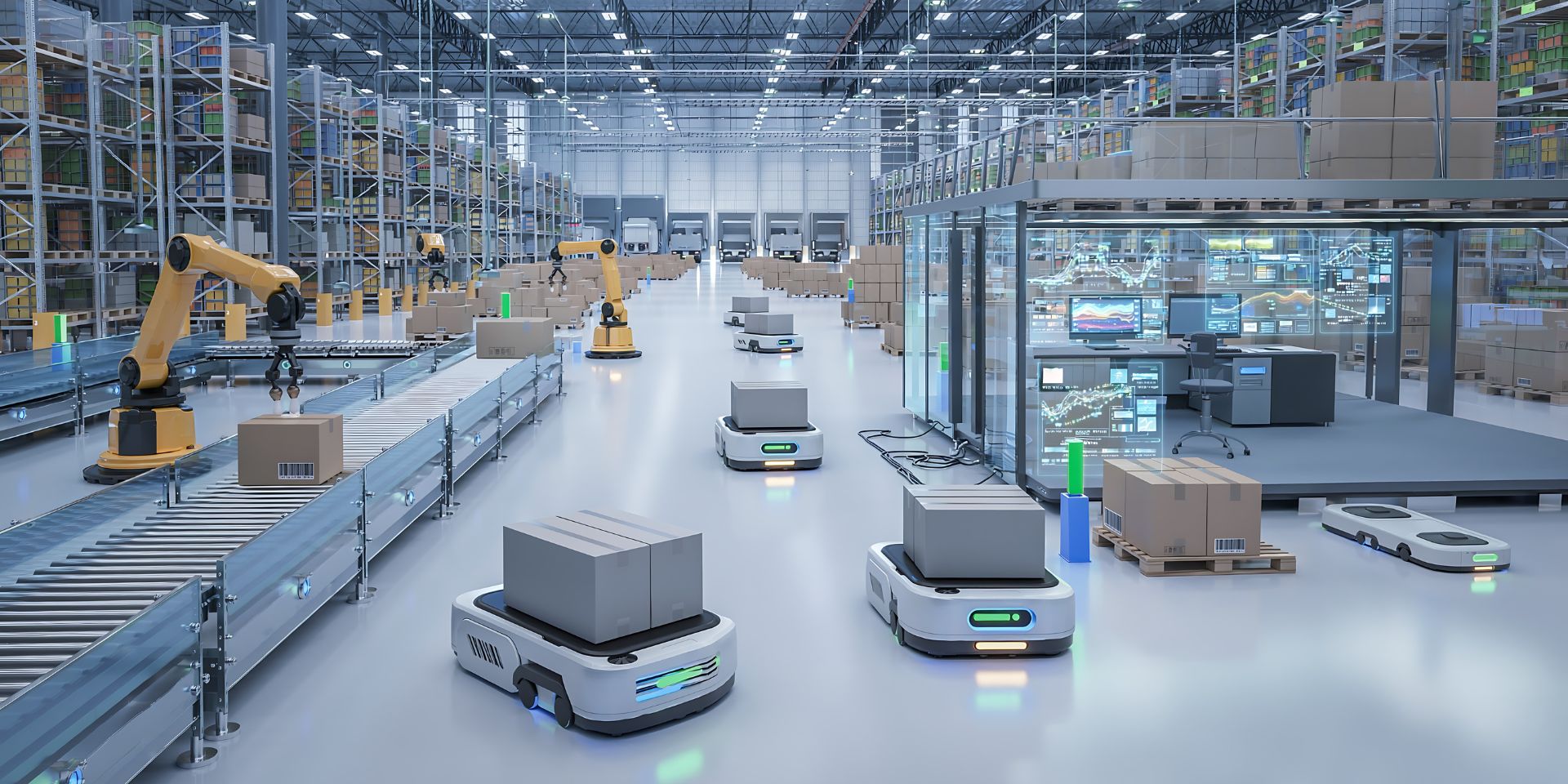
Automation in intralogistics: How intelligent systems speed up material flows
Automation in intralogistics is becoming a key competitive factor for industrial, retail and logistics companies. Rising costs, a growing shortage of skilled workers, fluctuating order volumes and increasing demands on delivery speed and quality are putting greater pressure on internal processes. At the same time, driverless transport systems, autonomous mobile robots, intelligent warehouse management and the use of artificial intelligence (AI) are opening up entirely new possibilities for managing material flows and the movement of goods more efficiently.
Successful intralogistics automation comes into play where physically demanding, monotonous or error-prone tasks can be automated. In return, staff take on more coordinating, supervisory and value-adding tasks.
In this article, we’ll introduce you to the benefits of intralogistics automation and also show you which automated logistics systems are already available today. You can also draw inspiration from examples of German companies when it comes to automating your intralogistics.
By the way: if you’d like further inspiration on automation in intralogistics, make the most of the Robotix Impact Summit 2026 as the ideal platform to exchange ideas with leading experts and take away practical solutions.
Automation in intralogistics: What are the benefits of intelligent control systems?
Automation in intralogistics means that in-house transport, warehousing and order-picking processes are carried out partly or even entirely autonomously with the aid of machines, robots and software. In-house logistics ranges from goods receipt through storage and production supply to preparation for dispatch. The aim of automation is to make these processes faster, more transparent and more reliable – and to relieve staff of particularly physically demanding, monotonous or error-prone tasks.
This is not merely about the movement of goods. Modern intralogistics automation links physical material flows with digital information flows. Systems therefore recognise where an item is located, what quantity is required, which transport route is available and when a production line needs to be supplied with materials. Warehouse management, conveyor technology, robotics and artificial intelligence are increasingly interlinked to achieve this.
The range of automated intralogistics solutions extends from digital assistance systems to largely self-managing warehouse automation – here are a few examples:
Scanners, pick-by-light and pick-by-voice systems assist staff with order picking and reduce picking errors
Automated industrial trucks handle routine transport of pallets, containers or components
Driverless transport systems (DTS) and autonomous mobile robots (AMR) transport goods to their destination independently and, in some cases, dynamically adjust their routes
Stacker cranes and shuttle systems automatically store and retrieve items
(Collaborative) robots, including cobots, pick, sort, pack or palletise goods
Warehouse management and material flow computers coordinate stock levels, orders, equipment and vehicle fleets
Artificial intelligence optimises routes, identifies bottlenecks, forecasts utilisation rates and supports predictive maintenance
The extent to which a company can automate its intralogistics processes depends on the product mix, order volume, the building, the investment budget and the need for flexibility. Full automation is therefore not always the most sensible goal. Particularly in existing warehouses and production environments, flexible intralogistics automation can be much more promising: companies start with a clearly defined process, gain experience and then expand the solution step by step.
It is crucial not to focus solely on individual machines when considering automation. Only when automated logistics systems are integrated with warehouse management, production planning and the existing IT infrastructure does a seamless, intelligent material flow emerge. In this way, isolated technology is transformed into a high-performance intralogistics chain that can also adapt to changing volumes, product variants and market requirements.
Market analysis: How great is the potential for intralogistics automation?
There is no definitive figure for the current level of intralogistics automation in industry, as studies tend to group together different technologies and market segments. Some studies focus exclusively on warehouse automation, whilst others include industrial trucks, cranes, warehouse technology, mobile robots and traditional material handling systems.
The VDMA, for example, estimated the production volume of German conveyor technology and intralogistics suppliers for 2024 at around 27.7 billion euros. German export volume for the same year stood at 19.8 billion euros. Globally, intralogistics products worth around 122.5 billion euros were already exported in 2023. However, these figures reflect the entire intralogistics sector, not just automated solutions.
For the more narrowly defined global warehouse automation market, Global Market Insights estimates the volume for 2024 at 26.5 billion US dollars. According to the forecast, this is set to grow to US$115.8 billion by 2034. Such forecasts should be interpreted with caution due to differing market definitions, but they do illustrate the expected momentum.
Mobile robotics is experiencing particularly strong growth. According to the International Federation of Robotics, around 102,900 professional service robots for transport and logistics were sold in 2024 – 14 per cent more than in the previous year. This application category thus accounted for more than half of all professional service robots recorded.
Benefits: Why is automation worthwhile in intralogistics?
Automated logistics delivers the greatest benefits when companies focus not on a specific technology, but on a clearly defined process problem. And this also applies to intralogistics automation,
Typical benefits may include:
Higher throughput:
Recurring goods movements can be carried out continuously and in a predictable manner.
Fewer errors:
Digital order management and automatic identification reduce picking errors and incorrect deliveries.
Reduced workload for staff:
Heavy, monotonous and ergonomically unsuitable tasks are handled by machines.
Greater transparency:
Warehouse management and material flow control provide real-time insights into stock levels, order status and system performance.
Better use of space:
Automated small-parts warehouses and high-bay warehouses can make efficient use of available space.
Greater process reliability:
Standardised processes make lead times and quality easier to plan.
Flexible scaling:
Modular AMR fleets can be expanded with additional vehicles as demand increases.
Options: What automated systems are available?
Depending on the product mix, process volume and building layout, various intralogistics solutions may be suitable for automation.
| SYSTEM | TYPICAL APPLICATIONS | KEY STRENGTHS |
| Automated material handling | Consistent transport routes with high volumes | High and continuous throughput |
| Automated Guided Vehicles (AGVs) | Recurring transport operations on defined routes | Reliable production supply |
| Autonomous Mobile Robots (AMRs) | Dynamic transport operations in changing environments | High flexibility |
| Automated forklift trucks | Pallet handling, storage and replenishment | Processes typical of forklift trucks |
| Stacker cranes and shuttles | Automatic storage and retrieval | High storage density and speed |
| Robot-assisted order picking | Gripping, sorting and staging of items | Automated repetitive manual tasks |
| Cobots | Collaboration with staff | Helpful support without complete separation |
| Warehouse management systems | Inventory and order control | Centralised transparency |
| Material flow computers | Coordination of equipment and vehicles | Optimised overall flow |
| AI systems | Forecasting, image recognition and route planning | High adaptability and optimisation |
The choice of the most suitable automation solution depends, amongst other things, on the dimensions and weights of the load units, order and throughput requirements, seasonal peaks and the spatial conditions. A technology that works well in an e-commerce warehouse is not necessarily suitable for the production logistics of a mechanical engineering firm.
Safety: What must intralogistics automation achieve?
Where people, industrial trucks and robots share the same spaces, safety must be taken into account right from the planning stage. Safety systems for intralogistics automation typically consist of several levels:
In addition, staff require clear instructions for normal operation, maintenance work and faults.
As systems become increasingly interconnected, cyber security is also growing in importance. Tampered-with order data, failed interfaces or inadequately protected remote maintenance access points can affect not only IT systems but also physical processes.
The forthcoming Regulation (EU) 2023/1230 on machinery, which comes into force in January 2027, takes greater account of the fact that software can also perform safety functions. Companies should therefore consider technical safety, IT security and operational organisation as a whole.
Practical tips: How to overcome the challenges of implementation
Many automation projects fail not because of the technology available, but because of unclear objectives, incomplete data or underestimated interface requirements. The following steps have proven effective for a successful implementation:
- Analyse processes:
Record movement routes, quantities, bottlenecks, errors and peak loads.
- Prioritise use cases:
Start with a clearly definable, frequently recurring process.
- Calculate the business case:
Take into account investment, operation, maintenance, energy, staff, floor space and service life.
- Plan IT integration:
Clarify the integration of systems, warehouse management, machinery and fleet control at an early stage.
- Carry out a pilot project:
Test the technology, user acceptance and process quality under real-world conditions.
- Involve staff:
Communicate objectives and changes transparently and provide training for teams.
- Prepare for scaling:
Define standards, interfaces and key performance indicators before automating further areas.
High initial costs, technical dependencies and increasing maintenance requirements remain significant challenges. In a survey published by Unitechnik, companies cited high investment costs and low flexibility as the key decision-making factors. At the same time, however, 70 per cent of respondents could envisage making further investments in automation solutions.
Best practices: What does intralogistics automation look like in German companies?
Example 1: BMW – networked transport robots in Regensburg
At the BMW Group plant in Regensburg, just under 50 automated tugger trains and more than 140 smart transport robots are connected via a cloud-based traffic management system. The fleet handles around 10,000 parts deliveries every working day. The vehicles used vary according to their task and payload – some autonomous systems can even transport loads of up to 55 tonnes.
This example demonstrates how devices from different manufacturers, autonomous vehicle types and varying degrees of automation can be orchestrated via a central platform.
Example 2: Zalando – flexible AMRs for goods dispatch
Zalando uses autonomous mobile robots from Idealworks in its logistics centres in Mönchengladbach and Lahr. The AMRs transport orders ready for dispatch and replace physically demanding hand-trolley transport. They can move goods weighing up to 1,000 kilograms and are connected to Zalando’s IT system via a cloud platform.
The scalability is particularly noteworthy: the vehicles can be redeployed between sites and adapted to seasonal demand.
Example 3: DHL – Robotics on an industrial scale
The DHL Group has invested more than one billion euros in the automation of its contract logistics over the past three years. In 2025, the company, together with Boston Dynamics, announced plans to deploy more than 1,000 additional robots. According to the company, the Stretch robot can unload up to 700 cartons per hour from containers.
The project illustrates how robotics can initially be introduced for a specific process and subsequently adapted for other applications, such as order picking.
Example 4: Schaeffler – humanoid robots & Physical AI
In 2025,Schaeffler and Neura Robotics entered into a technology partnership for humanoid robots. Schaeffler intends to deploy the systems across its production network and integrate a mid-four-figure number of them by 2035. Real-world production data will be used to help train the robots’ industrial capabilities.
Humanoid robots are still at an early stage in many areas of application. However, they could become of interest in the future in situations where conventional systems are too inflexible due to changing tasks, human-centred workstations or low production volumes.
Future prospects: What trends are shaping automated intralogistics?
The future does not lie solely with large, fully automated systems. Intralogistics solutions that can be quickly adapted and integrated into existing structures will become particularly relevant, first and foremost:
Physical AI:
AI systems use cameras and sensors to gain an understanding of their physical environment and can derive actions from this.
Humanoid robots:
Human-like systems are designed to take on a variety of gripping, transport and handling tasks without the need for a complete overhaul of workstations.
Intelligent fleet management:
Various AMRs, AGVs and automated industrial trucks are coordinated across different manufacturers.
Robot-as-a-Service:
Companies rent robotic services and pay on a pay-as-you-go basis, rather than incurring high initial investments.
Digital twins:
Material flows and plant layouts are simulated prior to implementation. This allows bottlenecks, capacities and investment options to be assessed at an early stage.
Conclusion: Approach intralogistics automation strategically rather than in isolation
The automation of intralogistics offers companies the opportunity to speed up material flows, reduce errors and specifically ease the workload on staff. Success, however, depends less on the maximum level of automation than on finding the right solution for the process in question.
You should therefore start by analysing bottlenecks and repetitive tasks. Begin with a commercially viable use case, ensure open interfaces, and involve your staff at an early stage. This will enable individual technologies to be combined into a high-performance, flexible and secure intralogistics chain.
Tip: If you want to play an active role in shaping the future of robotics, AI and automation, you should attend the Robotix Impact Summit 2026. There, specialists and managers will gain valuable insights into the latest developments, technologies and practical applications relating to the smart factory of tomorrow.
FAQ: 7 common questions about intralogistics automation – with concise answers
1. What is intralogistics?
Intralogistics encompasses the organisation, control, execution and optimisation of all internal material flows, information flows and goods movements within a company – from goods receipt to dispatch.
2. What is the difference between logistics and intralogistics?
Logistics covers the entire supply chain right through to delivery, whilst intralogistics focuses on all internal transport, warehousing and information processes. External transport logistics is not part of intralogistics.
3. What does intralogistics automation mean?
In intralogistics automation, machines, robots and software take over individual or multiple internal logistics processes, either partially or completely, on their own.
4. Which processes lend themselves particularly well to automation?
Recurring transport operations, the storage and retrieval of goods, as well as order picking, sorting, packing and palletising, are particularly well suited to the automation of intralogistics processes.
5. What is the difference between AGVs and AMRs?
Traditional automated guided vehicles (AGVs) mainly move along predefined routes, whilst autonomous mobile robots (AMRs) map their surroundings and plan their routes more dynamically.
6. Is automation also worthwhile for medium-sized companies?
Yes, intralogistics automation can be achieved gradually – without immediate full automation – through modular systems, pilot projects and rental models.
7. What role does artificial intelligence play in intralogistics automation?
In intralogistics, artificial intelligence (AI) supports, amongst other things, image recognition, route optimisation, demand forecasting, fault detection and predictive maintenance.

About the author
Nicole Wohnhaas
For more than 16 years, Nicole Wohnhaas has been developing conference and event formats focused on future-oriented topics in business and industry. As Congress Director of Product & Sales for the ROBOTIX Impact Summit, she is responsible for the event’s content strategy and maintains close ties with industrial companies, technology providers, and innovation leaders.
In her articles, she analyzes developments in robotics, automation, and AI and assesses their impact on production, logistics, and industrial value creation. Her focus is on practical use cases, technological trends, and the strategic issues surrounding industrial transformation.
Do you like what you read? Share this post or leave us a comment!
Comments
No Comments
Write comment

© Management Circle AG 2026